
Garage Floor Coatings in Utah: What Homeowners Should Know Before Hiring a Contractor
If you're researching garage floor coatings in Utah, you've probably already noticed something confusing.
One company calls it epoxy. Another calls it polyurea. Another says polyaspartic. Nearly everyone says their system is "industrial-grade," and most finished garage floors look pretty similar in photos.
But the finished picture doesn't tell you much about what is underneath it.
At MDRN Concrete Specialties, we install concrete coating systems throughout Utah in everything from residential garages to large commercial and municipal facilities. We've completed garage floors in homes across the Wasatch Front, but we've also been trusted to coat demanding commercial spaces.
That experience has taught us that the most important part of a garage floor isn't necessarily the part you see.
It's how the concrete was prepared and what was installed on top of it.
Here's what we think Utah homeowners should know before choosing a garage floor coating company.
Epoxy vs. Polyaspartic Garage Floor Coatings
Let's start with one of the most common questions we hear:
Do you install epoxy garage floors?
People commonly use "epoxy flooring" to describe almost any decorative garage floor coating. It's become a generic term homeowners recognize.
But epoxy and polyaspartic aren't the same thing.
At MDRN Concrete Specialties, we specialize in polyaspartic garage floor coatings rather than relying on a traditional epoxy system for our residential garage floors.
Polyaspartic coatings offer several advantages for garage environments, including fast cure times, excellent abrasion resistance and UV stability.
That last one is especially important in garages where sunlight regularly reaches the floor through open garage doors or windows.
The coating itself matters, but there's something we consider even more important.

Ask How Your Garage Floor Will Be Prepared
If you're comparing garage floor coating estimates, ask every contractor this question:
How are you preparing my concrete before you coat it?
A coating has to bond to the concrete underneath it.
That's why professional surface preparation is such an important part of our installation process.
We mechanically grind the concrete to create the appropriate surface profile before applying the coating system.
Grinding also gives us an opportunity to get a much better look at the condition of the slab.
Cracks, previous coatings, contaminants, repairs and other issues can all affect how a floor should be approached.
Simply putting an expensive coating over poorly prepared concrete doesn't create a premium garage floor.
The foundation of the system is the preparation.

Why Utah Garages Are Hard on Concrete Floors
Garage floors in Utah experience conditions that aren't necessarily an issue in every part of the country.
During the winter, your vehicles can bring snow, water, road salt and deicing chemicals into the garage.
Then summer arrives and the same garage can experience significant heat.
Add vehicles, hot tires, oil, tools, lawn equipment, storage, dirt and everyday traffic, and your garage floor sees quite a bit of abuse.
Bare concrete is also porous, which means spills and contaminants can penetrate the surface and become difficult to clean.
A properly installed garage floor coating creates a finished surface that is considerably easier to maintain while protecting the concrete underneath.
For many homeowners, the biggest difference isn't even how the garage looks.
It's how much easier it is to keep clean.
Why Do Some Garage Floor Coatings Peel?
You've probably seen one.
A garage floor that looked great when it was installed but eventually started peeling around the tires or lifting in sections.
There isn't one universal reason a coating fails.
The condition of the concrete, moisture, contamination, preparation, application and coating system can all play a role.
That's why we're cautious when someone tells you that one particular product automatically guarantees a good floor.
It doesn't.
A great product installed incorrectly can still produce a bad result.
We put a significant amount of emphasis on mechanical preparation because the bond between the concrete and coating is critical to the finished system.
What Is a Full-Flake Garage Floor?
The decorative chips you see in many professionally coated garages are generally referred to as flakes.
They're not just there to make the floor look good.
A full-flake broadcast creates texture, helps disguise dirt and imperfections, and gives homeowners a huge range of options for the appearance of their garage.
After the flake is broadcast, the excess material is removed and the floor receives its protective topcoat.
The result is the clean, finished garage-floor appearance most homeowners associate with professional concrete coatings.
And it doesn't have to look overly busy.
There are flake combinations that work extremely well with modern Utah homes, from subtle gray and neutral blends to warmer colors that complement the home's exterior and interior finishes.

Garage Floor Coatings Aren't Just About Appearance
We understand why people initially want their garage coated.
It looks better.
A bare gray concrete floor can make an otherwise beautiful garage feel unfinished. Coating the concrete completely changes the space.
But appearance is only one reason we install garage coatings.
A professionally coated garage floor is also:
Easier to clean.
Dust, dirt, road grime and spills are much easier to remove from a coated surface than porous bare concrete.
More resistant to staining.
Oil and other common garage contaminants don't penetrate a properly coated surface the way they can penetrate bare concrete.
Designed for vehicle traffic.
The system is built around the fact that cars and trucks will actually be driven and parked on it.
A finished part of the home.
More homeowners are treating garages as an extension of their living space rather than an unfinished storage area.
And in Utah, where garages often store everything from vehicles and skis to bikes, fishing gear, tools and recreational equipment, having a clean and usable space makes a noticeable difference.
Not All "Industrial-Grade" Garage Floors Are the Same
You'll see the words industrial-grade on a lot of garage floor coating websites.
We use professional coating products too, but we think homeowners should look beyond the phrase.
Ask what the contractor actually does.
Ask how they prepare the concrete.
Ask what coating system they're installing.
Ask how they handle cracks and joints.
Ask what happens if they discover an existing coating or unexpected concrete condition.
Ask who is actually doing the work.
Those answers tell you considerably more than a marketing phrase.
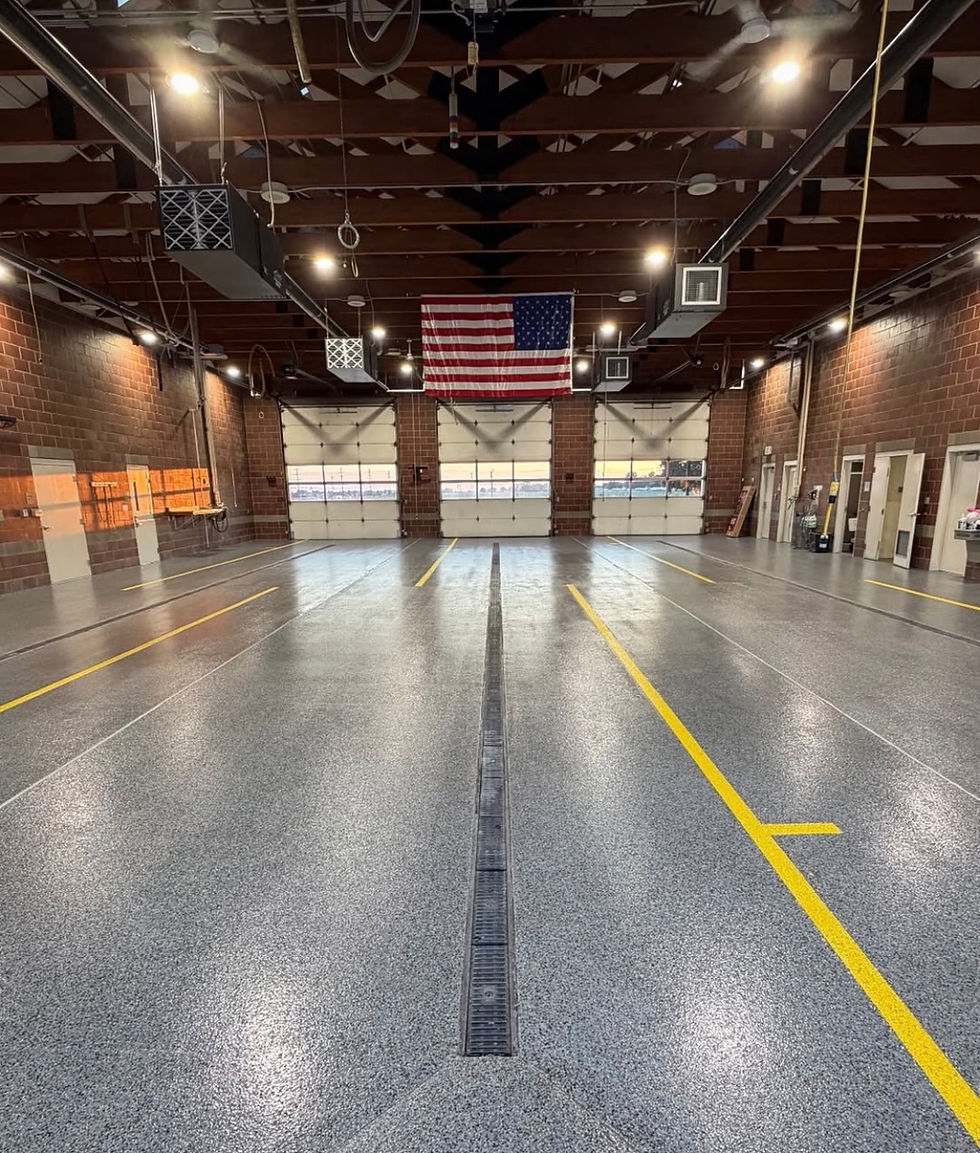
The Same Company That Coats Fire Stations Can Coat Your Garage
You don't need to own a commercial building to get professional concrete work.
Whether we're coating a municipal facility or a three-car garage in a Utah neighborhood, we're thinking about many of the same fundamentals:
What condition is the concrete in?
How should it be prepared?
What coating system makes sense for the space?
How will the floor actually be used?
That's the difference between approaching concrete coatings as a system and simply putting something over the floor.
How Much Does a Garage Floor Coating Cost in Utah?
This is one of the first questions homeowners ask, and it's also one of the hardest to answer without seeing the garage.
The price of a professional garage floor coating can depend on:
Garage square footage
Condition of the concrete
Existing coatings
Cracks or repairs
Steps and vertical surfaces
Coating system
Flake selection
Additional preparation required
Be cautious about comparing estimates based exclusively on price per square foot.
Two contractors can quote the same garage while proposing very different preparation and coating systems.
The better question is:
What am I actually getting for the price?
Can You Coat an Older Garage Floor?
Usually, yes.
A garage doesn't need brand-new concrete to be coated.
In fact, we regularly work with existing concrete that has cracks, staining, surface wear or previous treatments.
Older concrete simply needs to be evaluated first.
There are situations where additional preparation or repairs are necessary, and occasionally we'll find concrete conditions that change what we recommend.
We'd rather identify those issues before installation than cover them up and hope for the best.
What About New Construction Garages?
New construction is one of our favorite times to coat a garage.
Before shelving, cabinets, tools and years of accumulated belongings fill the space, we can start with an empty garage and create a finished floor from the beginning.
If you're building a custom home in Utah, we'd recommend considering the garage floor alongside the other finishes you're selecting for the home.
You've probably spent time choosing flooring, countertops, cabinets, exterior materials and paint colors.
The garage floor is one of the largest surfaces in the garage.
It doesn't have to remain unfinished concrete.
Garage Floor Coatings for Utah Homes
MDRN Concrete Specialties installs professional polyaspartic garage floor coatings throughout Northern Utah and the Wasatch Front, including Layton, Farmington, Kaysville, Fruit Heights, Bountiful, Salt Lake City, Holladay, Cottonwood Heights, Draper, Park City, Heber City, Midway, Alpine, Highland, Lehi and surrounding Utah communities.
From two-car residential garages to large custom garages and municipal facilities, our focus stays the same:
Properly prepare the concrete. Use professional materials. Don't cut corners on the installation.
We've been trusted with fire stations.
We've been trusted with commercial facilities.
And we'll bring that same attention to the garage attached to your home.
If you're considering a garage floor coating in Utah, contact MDRN Concrete Specialties for an estimate. We'll look at your concrete, explain the system we recommend and help you decide whether a professional coating is the right fit for your garage.


Comments